

 Facebook
 X
X
 Pinterest
 Copy Link
Why Is It So Expensive to Buy a Home in Santa Cruz, CA?
Santa Cruz is one of the most beautiful places to live in California. It offers beaches, redwood forests, mild weather, and a relaxed coastal lifestyle. However, all of that comes with a major downside: buying a home here is extremely expensive.
So why does Santa Cruz cost so much compared to other California markets? The answer comes down to a mix of supply, demand, geography, and long-standing development challenges.
Let’s break it down.
1. Santa Cruz Has More Buyers Than Homes
First, demand in Santa Cruz stays consistently high. People want to live near the ocean, close to nature, and within commuting distance of Silicon Valley.
At the same time, Santa Cruz is a small housing market. There simply aren’t many homes for sale at any given time. When more buyers chase fewer listings, prices rise. This imbalance is one of the biggest drivers of high home values.
2. Geography Limits New Construction
Next, Santa Cruz cannot expand easily.
The city sits between the Pacific Ocean and protected redwood forests. Mountains, coastal zones, and environmental protections limit where new housing can go. Unlike inland cities, Santa Cruz cannot sprawl outward.
As a result, housing supply grows very slowly, even when demand increases.
3. Strict Zoning and Long Approval Timelines
In addition to geography, local regulations slow development.
Zoning rules often restrict density. Environmental reviews take time. Community opposition can delay or stop projects entirely. While these rules protect Santa Cruz’s character, they also reduce the number of homes that reach the market.
Fewer new homes mean higher prices for existing ones.
4. Building Homes Here Costs More
Even when builders get approval, construction costs remain high.
Labor is expensive. Materials cost more. Impact fees and permitting costs add tens of thousands of dollars per unit. All of those costs get passed on to buyers.
This makes it difficult to create truly affordable new housing in Santa Cruz.
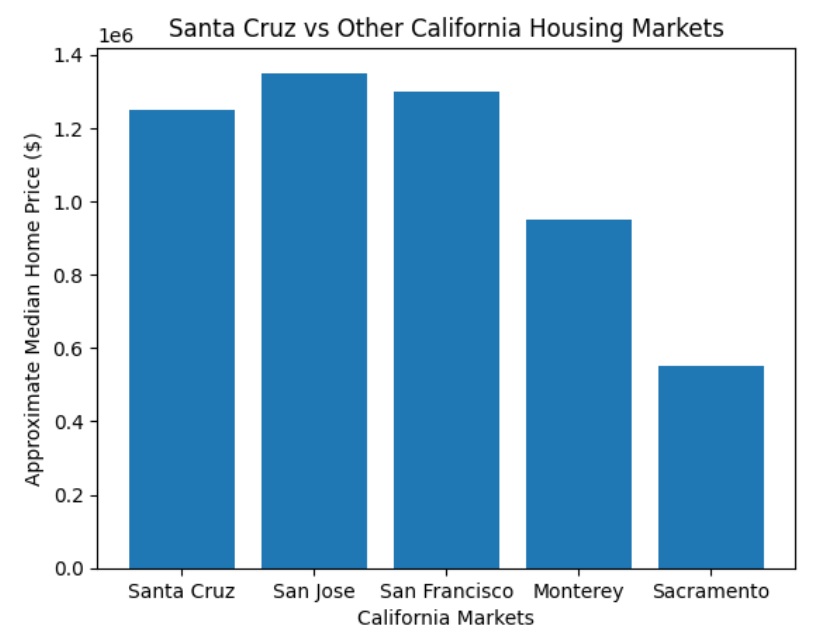
5. Santa Cruz vs Other California Markets
To understand how expensive Santa Cruz really is, it helps to compare it to other California cities.
The chart above shows approximate median home prices across several markets:
-
Santa Cruz: ~$1.25M
-
San Jose: ~$1.35M
-
San Francisco: ~$1.30M
-
Monterey: ~$950K
-
Sacramento: ~$550K
While Santa Cruz is smaller than San Jose or San Francisco, its prices remain competitive with major tech hubs. That surprises many buyers.
Why This Comparison Matters
Santa Cruz does not have the same job density or income levels as Silicon Valley. Yet, home prices remain similar. This gap highlights how limited supply and lifestyle demand, not just jobs, drive prices here.
6. Investors Add Extra Competition
Another factor is investor activity.
Second-home buyers, short-term rental owners, and long-term investors all compete with local buyers. Every investor purchase removes another home from the pool of primary residences.
That competition pushes prices higher, especially in desirable neighborhoods.
7. The Lifestyle Premium Is Real
Finally, Santa Cruz carries a lifestyle premium.
Buyers pay more for:
-
Ocean access
-
Outdoor recreation
-
Walkable neighborhoods
-
Mild coastal climate
Many buyers accept higher prices because they value quality of life over square footage. This emotional demand keeps prices elevated even when markets slow.
What This Means for Buyers
If you’re thinking about buying in Santa Cruz, here’s the reality:
-
Entry prices are high, even for smaller homes
-
Inventory remains limited
-
Well-priced homes still move quickly
-
Long-term value remains strong due to scarcity
However, opportunities still exist with the right strategy, timing, and local knowledge.
Bottom Line
Homes in Santa Cruz are expensive because people want to live here, but few homes are available. Geography, zoning, high construction costs, and lifestyle demand all work together to keep prices high.
Santa Cruz isn’t just competing with nearby cities. It’s competing with the most desirable markets in California.
If you want help understanding which neighborhoods offer the best value or how to compete as a buyer, that’s where local expertise makes the difference.
